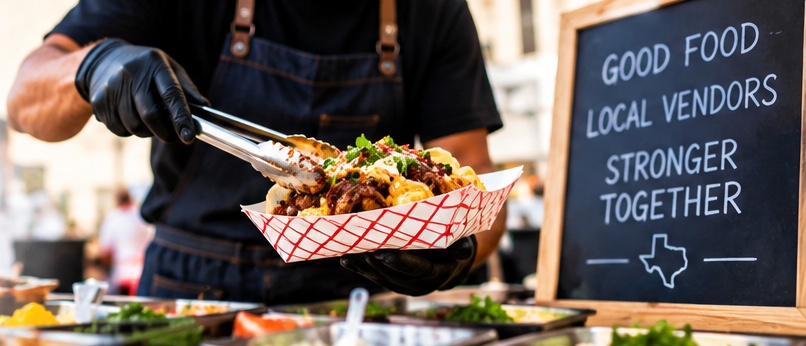

Texas mobile food vendors have a new permit path to pay attention to.
As of today, June 4, 2026, the Texas Department of State Health Services has made the Mobile Food Vendor application available through DSHS Online Licensing Services. The statewide licensing change takes effect July 1, 2026, and vendors should not wait until the last week of June to understand where they fit.
Start the DSHS Online Licensing application here.
This change matters because Texas is moving mobile food vendor licensing into a statewide DSHS process. DSHS says that beginning July 1, 2026, mobile food vendors must be licensed with DSHS to operate a food vending vehicle in Texas. DSHS also states that an initial pre-licensing inspection must be performed before the license is issued.
What Changed
Before this rollout, many mobile vendors had to work through local health departments city by city, county by county, and event by event. Under the new DSHS framework, mobile food vendors will apply through the state licensing system and be placed into a license type based on food preparation activity.
DSHS currently describes three mobile food vendor types:
- Type I: lower-risk vendors that do not sell time and temperature control for safety foods, such as prepackaged non-TCS snack vendors.
- Type II: vendors selling prepackaged TCS food with limited handling, or food prepared to order and served for immediate consumption. DSHS examples include coffee trucks, snow cone vendors, and hot dog vendors.
- Type III: vendors that prepare, cook, hold, and serve food from a food vending vehicle. DSHS examples include burger, BBQ, and taco trucks.
The practical takeaway is simple: your license type will depend on what you actually do on the unit, not just what you call your business.
What Vendors Should Do Now
- Go to the DSHS Online Licensing Services page and begin the application process.
- Know your current permit situation before you apply.
- Gather proof of your existing local mobile food unit or mobile food vendor license, if you have one.
- Identify the food preparation activity on your unit so you can understand whether you are likely Type I, Type II, or Type III.
- Gather the vehicle, menu, insurance, and location information listed below.
- Save and print your DSHS application summary.
- Keep that application summary on your food vending vehicle while the application is pending, if DSHS places you in the existing-license applicant category.
What To Have Ready Before You Apply Today
The online form may ask for more based on your operation, but vendors should have these items ready before starting:
- Applicant and business information: applicant name, business name, address, email, phone number, and any documents showing the relationship between the applicant and business entity.
- Texas sales tax ID: DSHS guidance for retail food establishments says applicants must have a sales tax ID number before submitting a permit application.
- Current local permit, if you have one: if you already hold a local mobile food unit or mobile food vendor license in Texas, keep a copy ready.
- Recent inspection documents, if you have them: a recent local health inspection report is useful backup. If you use a central preparation facility or commissary, be ready with CPF authorization and the CPF inspection report if required.
- Driver’s license: anyone driving a motorized food vending vehicle must have the required driver’s license, and a commercial driver’s license if required.
- Vehicle or trailer information: for each motorized food vending vehicle, have the license plate number, vehicle description, vehicle identification number, registration, proof of vehicle insurance, proof of vehicle weight issued by TxDOT, and any required commercial vehicle license or permit.
- Menu or product list: DSHS asks for a copy of the menu or a list of all food and beverage products to be prepared, sold, or served.
- Process description: be ready to describe what happens on the unit, such as prepackaged non-TCS snacks only, cook-and-serve, cook-cool-reheat-serve, hot holding, cold holding, reheating, or other food processes.
- Itinerary or operating locations: DSHS rules call for a list of planned operating locations and an itinerary with dates and times. Vendors may provide this through a website or social media page if that is where the schedule is maintained.
- Food safety documents: be ready with Certified Food Protection Manager and Food Handler documentation where required by your operation type.
- Servicing and commissary records: be ready with central preparation facility authorization, servicing area documentation, and authorization to use water, wastewater, grease, and waste disposal locations if those locations are not owned by the vendor. <